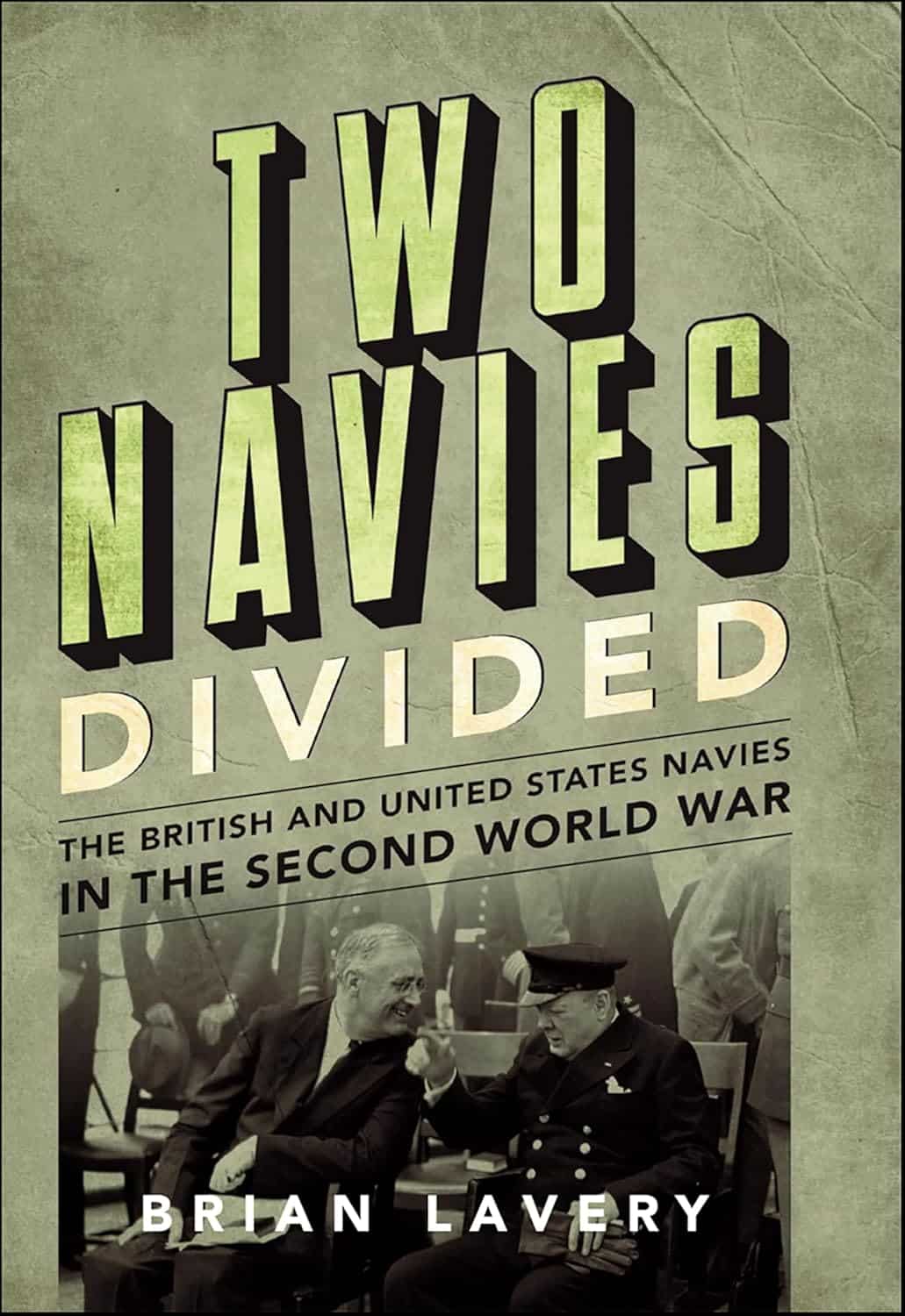
TWO NAVIES DIVIDED The British and United States Navies in the Second World
Original price was: £35.00.£11.99Current price is: £11.99.
A sweeping, authoritative comparison of the Royal Navy and U.S. Navy in the Second World War, this tour de force charts how two kindred yet contrasting services combined to defeat the Axis at sea. Richly structured and enlivened by first-hand accounts, it spans culture, command, technology, and global operations. Unflinching on failures as well as triumphs, it is an impressively researched, highly readable study—essential for naval historians and compelling for general readers alike.
Only 19 left in stock
Description
Borrowing its title from George Bernard Shaw’s wry observation, this incisive study deftly explores how two navies sharing common roots nonetheless diverged in practice, culture, and purpose during the Second World War. Brian Lavery offers a lucid, balanced comparison of the Royal Navy and the United States Navy, illuminating not rivalry but productive difference at a moment of existential conflict.
What emerges is a compelling narrative of parallel evolution. Both services stumbled early,Norway, Pearl Harbour, Savo Island,yet matured into formidable forces, their effectiveness ultimately underpinned by largely citizen crews. Lavery is particularly sharp on institutional contrasts: British officer entry shaped by class, American by patronage, with the latter arguably fostering broader early perspectives.
His technical and social observations are equally engaging. From divergent gunnery philosophies to the telling juxtaposition of British rum rations and American ice cream, the analysis captures both machinery and morale. The breadth is impressive,aviation, antisubmarine warfare, ship design, personnel, and more,without ever losing analytical clarity.
Brian Lavery is the best-selling author of more than thirty books on maritime history including the highly successful Nelson’s Navy and Empire of the Seas. He was for many years senior curator at the National Maritime Museum at Greenwich, and he served on the advisory committee that dealt with the most famous preserved ship in the world, HMS Victory.
Additional information
| Author/Editor | Brian Lavery |
|---|---|
| Product Code | 32556 |
| Delivery | This item is usually dispatched Next Day |
| Format | Hardback 613 pages illustrated throughout |
| ISBN | 9781399047210 |
| Condition | New |
|---|
You may also like…
![No. 12 The Attack on St. Nazaire 28th March, 1942 [British Navy]
NAVAL STAFF HISTORY SECOND WORLD WAR BATTLE SUMMARIES](https://www.naval-military-press.com/wp-content/uploads/2026/04/6117xAHpoAL-1._SL1360_-500x647.jpg)
![Naval Operations off Ceylon Mar.-Apr. 1942 (Also) No.16 Naval Operations at the capture of Diego Suarez (Operation “Ironclad”) May 1942 [1943, British Navy]
NAVAL STAFF HISTORY SECOND WORLD WAR BATTLE SUMMARIES
No.15](https://www.naval-military-press.com/wp-content/uploads/2026/03/9781474542203-front-500x647.jpg)
![No. 13 Actions with Enemy Disguised Raiders 1940-1941 [British Navy]
NAVAL STAFF HISTORY SECOND WORLD WAR BATTLE SUMMARIES](https://www.naval-military-press.com/wp-content/uploads/2026/04/61orf-xPSYL._SL1360_-500x647.jpg)