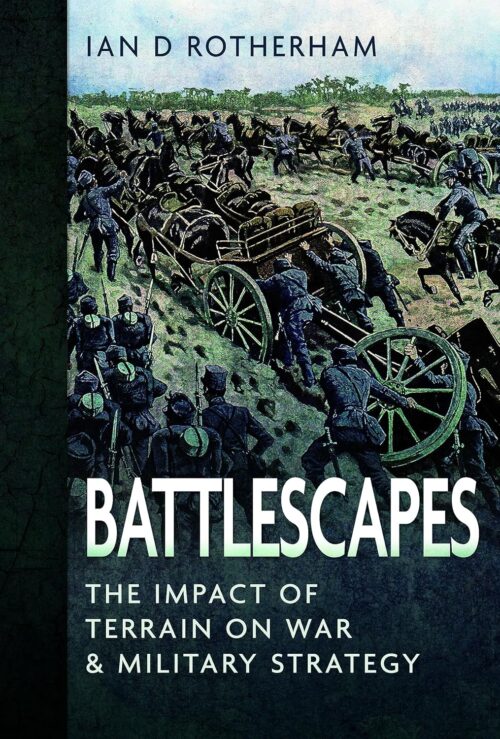


BATTLESCAPES The Impact of Terrain on War and Military Strategy
Original price was: £35.00.£14.99Current price is: £14.99.
Rotherham is a Professor of Environmental Geography, brings a distinctive interdisciplinary lens to Battlescapes, exploring the geography of war and its cultural, social, and environmental dimensions. Ranging broadly across periods from antiquity to the twenty-first century, the study frequently foregrounds wetlands as case studies to demonstrate how terrain,or its absence,shapes conflict.
Rather than offering linear narrative, Rotherham moves fluidly between examples and scales, requiring readers to shift interpretative frameworks. The result is a wide-ranging, occasionally digressive but consistently thought-provoking account that will appeal to both military history specialists and general readers.
A notable strength lies in its Integration of black-and-white visual material,photographs, drawings, paintings, and prints,which, whether tightly or loosely aligned with the text, consistently enhances engagement. Overall, it is a stimulating and unconventional contribution to the study of military geography.
In stock
Description
Throughout history, nature—its resources, terrain, and landscapes—has shaped the tactics and outcomes of warfare. From the medieval English Fens to the twentieth-century Iraqi Marsh Arabs, wetlands and marginal environments have fostered resistance and dissent. Harnessed by communities under threat, such terrain has repeatedly influenced military strategy. Water and marshland impeded campaigns in the Florida Everglades and during the Franco-Prussian War of the late nineteenth century. In the Second World War, Dutch forces deliberately flooded polders to halt the Nazi advance, while in 1938 Chinese nationalist forces breached the Yellow River dykes to impede Japanese progress.
Mountain ranges and deserts have likewise long served as refuges for resistance movements. From the former Yugoslavia to Afghanistan, these complex battlescapes cut across time and geography. Libyan fighters resisted Italian forces from the caves and valleys of the Green Mountains, while the Welsh used mountainous terrain to defend their principalities against the Normans.
This comprehensive study brings together landscapes, heritage, and the material traces of both defensive and offensive warfare, offering an integrated perspective on the enduring relationship between environment and conflict.
Overseas clients please note: Due to excessively high wrapped weight shipping is weighted on this title
Additional information
| Author/Editor | Ian D Rotherham |
|---|---|
| Product Code | 32475 |
| Delivery | This item is usually dispatched Next Day |
| Format | Hardback 439 pages |
| ISBN | 9781399066112 |
| Condition | New |
|---|
You may also like…